 Megan Small
CASE STUDY · 2026
Agent Command Center
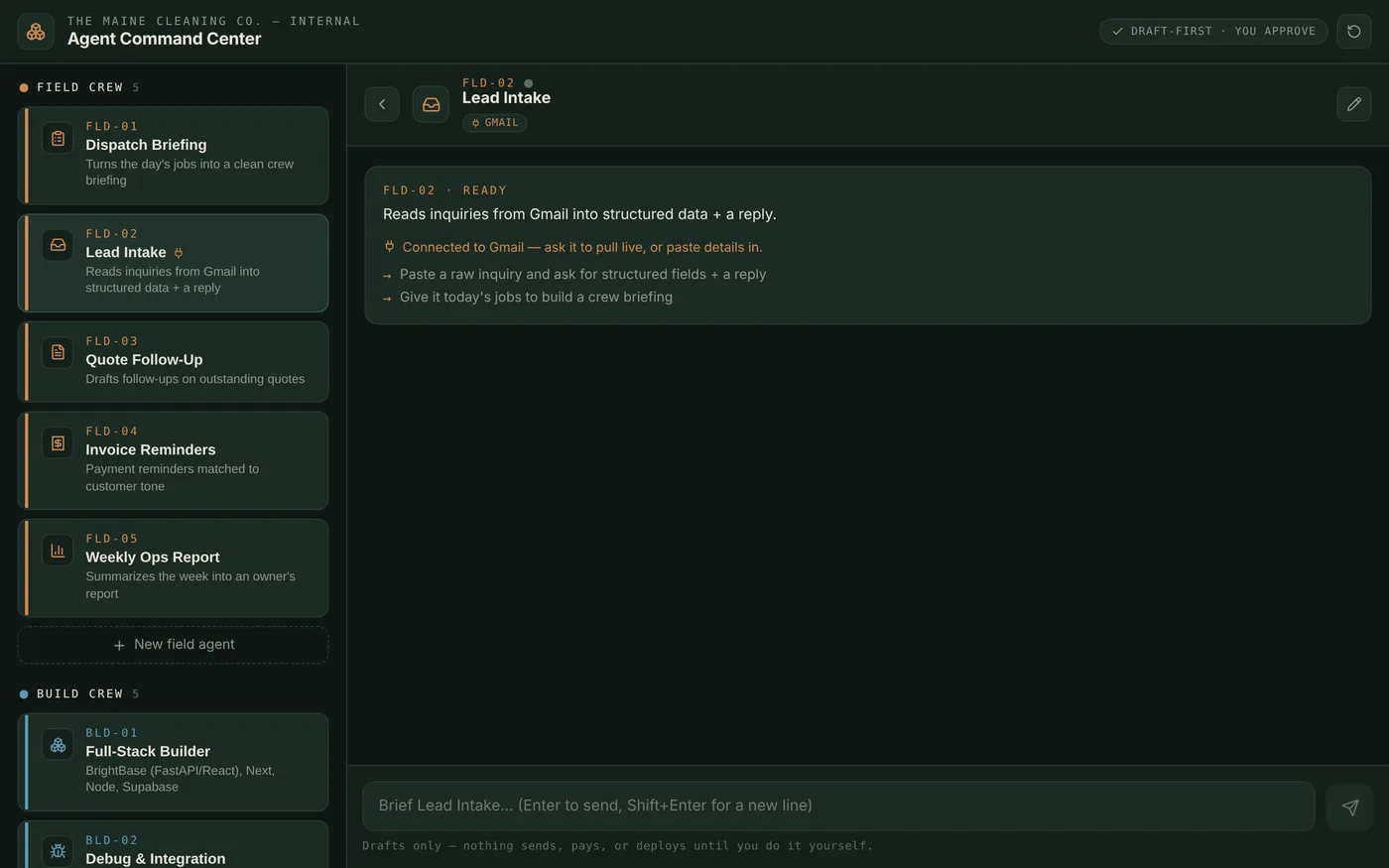
One console for a team of AI agents, grouped into crews for the business, for code and for school. Every agent hands back a draft, and a person approves anything that changes something.
- Role
- Design and build, solo
- Versions
- A browser version that runs inside Claude, and a local version on the Claude Agent SDK
- Stack
- React, Vite, FastAPI, WebSockets, Claude Agent SDK
- Rule
- Drafts first. Nothing sends, pays or deploys without a person’s tap
THE IDEA
Different work needs different rules
Business tasks, code changes and coursework each need their own instructions and their own limits. A dispatch briefing can read the schedule but should never message a customer. A build agent can edit code, but not without someone looking first. A tutor should explain and quiz, not do the work.
So each agent belongs to a crew, and the crew decides the rules. Shared business context and the crew’s rules are added to every agent automatically, including agents created later in the editor.
HOW A REQUEST MOVES
Reads run, writes wait
- 01PickChoose an agent from the roster and brief it
- 02ContextIts instructions, crew rules and any connectors are attached
- 03ReadReading and searching files or the web runs on its own
- 04PauseWriting a file or running a command waits for approval
- 05DecideApprove or deny each step from the console, even from a phone
DECISIONS
Four choices and what each cost
Rules belong to the crew
Field, Build and School each carry one rule set that every agent in the crew inherits, so a new agent starts out safe without anyone remembering to add it.
COSTChanging a crew rule changes every agent in that crew at once.
An approval gate on every change
In the local version, reading and searching tools are auto-approved. Writing files, editing them and running shell commands, git included, go through a gate that waits for a tap.
COSTA build task with many edits means many taps.
Connectors are read-only
Agents can pull from Gmail, Calendar, Drive and other connected tools to work with real information, but they are told never to send, reply, pay or delete through them.
COSTThe last step, like actually sending the reply, is still done by hand.
Runs on a machine I control
The local version runs as a background service on one computer and is reached over a private network, never the open internet, because anyone who can reach it can drive the build agents.
COSTIt needs a computer left on, and setup is not one click.
THE CREWS
Three crews, fifteen agents to start
Field crew
- Dispatch briefings a cleaner can run from a phone
- Lead intake: structured fields plus a reply draft
- Quote follow-ups and invoice reminders
- A one-screen weekly owner’s report
Build crew
- Full-stack building and systematic debugging
- Security and access-control review
- Schema design and migrations safe for live data
- OAuth and integration setup, with secrets never printed
School crew
- Tutors that explain in plain English first, then the formal version
- Printable study guides with practice questions
- Active-recall quizzes that check each answer
The roster is editable in the console: add an agent, pick its crew and connectors, and it inherits the draft-first rule.